> ## Documentation Index
> Fetch the complete documentation index at: https://docs.scanova.io/llms.txt
> Use this file to discover all available pages before exploring further.
# Page security
> Password-protecting individual pages in a multi-page QR code.
## Page-level vs. QR-level password protection
On a multi-page site, you can require a password to view an individual page — without password-protecting the whole QR code. Visitors can still see that the page exists in navigation; they just can't see its content until they enter the correct password.
This is different from **QR-level password protection**, set in the QR code's own settings, which hides the entire destination — visitors don't see anything, not even that other pages exist, until they enter the password. Page-level protection is more targeted: use it when most of your site should stay open but one or two pages need to stay private.
Live UI wording: the toggle is labeled **Password protection**, with helper text that reads **"Require a password before showing this page"** before you've set a password, and **"Visitors must enter a password before viewing this page"** once one is set.
## When to use page-level password protection
* A public event page with a members-only "Resources" page.
* A menu page that's open to everyone, plus a staff-only "Internal" page on the same QR code.
* A wedding site where the main details are public but a gift-registry or address page is shared only with close family.
If you want to hide the *entire* site behind one password — including the fact that it has multiple pages — use QR-level password protection instead, from the QR code's settings.
## Setting a password on a page
Open the page in the page builder and select it from the **Pages** list in the left sidebar.
In the right-hand inspector, make sure nothing is selected on the canvas so you're viewing the page-level tabs, then open **Settings**.
Under **PROTECTION**, turn on **Password protection**. A **Set a password** field and **Set password** button appear.
Enter a password and click **Set password**. A "Password saved" confirmation appears, the helper text updates to confirm protection is active, and a **Change password** link takes its place for future edits.
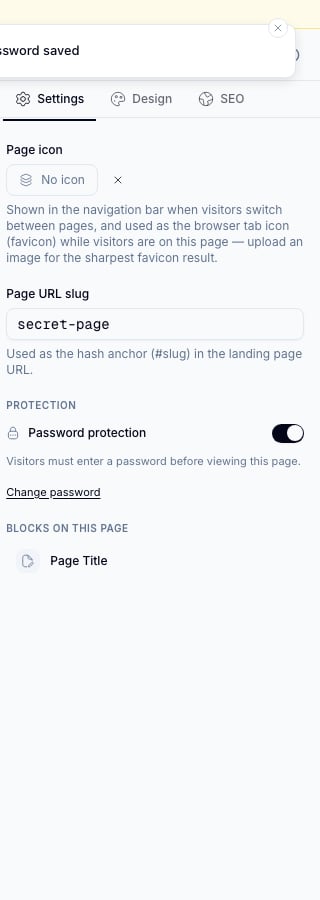 Publish your changes — the password takes effect for visitors once the QR code is published.
Password protection is set per page. If you have three pages and want all three protected, turn on **Password protection** separately on each one.
## What a visitor sees
Based on the product's own design intent (see [Publishing](/page-builder/publishing) for how the rest of the publish flow behaves):
* The protected page's navigation tab still shows its name and icon, so visitors know the page exists and is protected.
* Its content is replaced with a password prompt until the correct password is entered.
**Not independently re-verifiable in this pass.** The specific visitor-facing details — a lock icon next to the protected page's navigation tab, unlocking without a page reload, and the site remembering an unlocked page for 30 days on the same device — require an actually-published multi-page site reachable by an anonymous visitor session. That wasn't reachable from this verification environment (the published QR code's live short URL resolves to Scanova's public domain, not to anything servable from a local dev sandbox), so these three claims remain unverified rather than confirmed. Treat them as the product's documented intent rather than a live-tested fact until someone can check them against a real published site.
## Changing or removing a page's password
* **To change the password:** open the same **Protection** section and click **Change password**, enter a new one, and save. Visitors who already unlocked the page on their device will need to enter the new password the next time it's checked.
* **To remove password protection:** turn off the **Password protection** toggle and publish. The page becomes visible to everyone immediately.
## Using both QR-level and page-level protection together
You can combine the two if needed — for example, a QR-level password that protects the whole site, plus an extra page-level password on one especially sensitive page inside it. This isn't blocked, but if QR-level protection is already active, visitors already need a password just to reach any page at all, so double-check that layering both is really the setup you intend.
## Related
* [Multi-page navigation](/page-builder/multi-page-navigation) — how a protected page still appears in navigation.
* [Publishing](/page-builder/publishing) — when a page's password protection actually takes effect for visitors.
* [Page Builder overview](/page-builder/overview) — where the page-level Settings tab (including Password protection) lives.
Publish your changes — the password takes effect for visitors once the QR code is published.
Password protection is set per page. If you have three pages and want all three protected, turn on **Password protection** separately on each one.
## What a visitor sees
Based on the product's own design intent (see [Publishing](/page-builder/publishing) for how the rest of the publish flow behaves):
* The protected page's navigation tab still shows its name and icon, so visitors know the page exists and is protected.
* Its content is replaced with a password prompt until the correct password is entered.
**Not independently re-verifiable in this pass.** The specific visitor-facing details — a lock icon next to the protected page's navigation tab, unlocking without a page reload, and the site remembering an unlocked page for 30 days on the same device — require an actually-published multi-page site reachable by an anonymous visitor session. That wasn't reachable from this verification environment (the published QR code's live short URL resolves to Scanova's public domain, not to anything servable from a local dev sandbox), so these three claims remain unverified rather than confirmed. Treat them as the product's documented intent rather than a live-tested fact until someone can check them against a real published site.
## Changing or removing a page's password
* **To change the password:** open the same **Protection** section and click **Change password**, enter a new one, and save. Visitors who already unlocked the page on their device will need to enter the new password the next time it's checked.
* **To remove password protection:** turn off the **Password protection** toggle and publish. The page becomes visible to everyone immediately.
## Using both QR-level and page-level protection together
You can combine the two if needed — for example, a QR-level password that protects the whole site, plus an extra page-level password on one especially sensitive page inside it. This isn't blocked, but if QR-level protection is already active, visitors already need a password just to reach any page at all, so double-check that layering both is really the setup you intend.
## Related
* [Multi-page navigation](/page-builder/multi-page-navigation) — how a protected page still appears in navigation.
* [Publishing](/page-builder/publishing) — when a page's password protection actually takes effect for visitors.
* [Page Builder overview](/page-builder/overview) — where the page-level Settings tab (including Password protection) lives.